Introduction — why this comparison matters
Ever wondered why some workshops lose nights to troubleshooting while others run spotless shifts? The small differences in filtration strategy add up — fast. I’m talking about the unit at the heart of that difference: the laser cutter fume extractor, and how it shapes safety, uptime, and compliance in real shops. (Think: HEPA filters, activated carbon beds, airflow velocity numbers, PM2.5 monitoring — the real knobs we tune.)
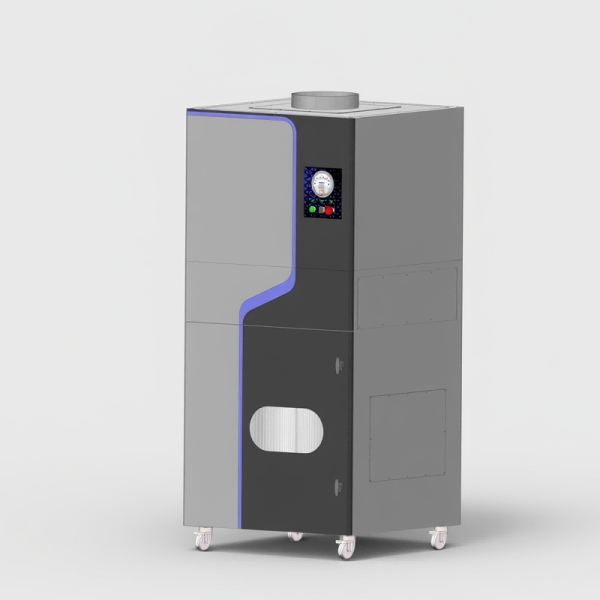
Here’s the scene: a mid-sized fabrication lab runs a 150 W fiber cutter six hours a day; local measurements show spikes in particulate and VOCs after routine metal cutting. Industry data suggests that poorly matched extraction reduces filter life by 30–50% and raises maintenance costs substantially. So what do we actually compare — and why does one extractor solve problems that another only masks? I’ll walk through the practical contrasts, share what I look for, and point out the red flags I’ve learned not to ignore. — funny how that works, right? Let’s dig into the pain points next.
Part 1 — Hidden user pain points in laser cutting fume extraction
I want to be blunt: many users assume a one-size-fits-all extractor will do the job, but real-world use disproves that fast. When we evaluate laser cutting fume extraction, the problems that surface most often aren’t flashy — they’re subtle leaks, overloads, and usage mismatches. I’ve seen shops with correct fan specs but poor duct design, and others where activated carbon is saturated long before teams notice odor issues. Look, it’s simpler than you think: filter type, capture strategy, and control logic must match the process load.
Why does the common setup fail?
First, capture efficiency is frequently overestimated. Folks quote nominal CFM numbers but ignore capture hood placement and airflow velocity at the source — the effective capture rate plummets if the hood is too far or the nozzle angle is wrong. Second, filter life gets killed by episodic spikes in particulate or VOCs; without PM2.5 and VOC sensors tied into control logic, units keep running on degraded media until performance collapses. Finally, serviceability is underrated. If a unit needs a specialist to swap a cartridge or recalibrate a sensor, shops delay maintenance, and performance decays. I’ve felt the frustration myself — you order a replacement filter and production slows for days. — and that’s costly.

Part 2 — New technology principles for better outcomes
Now, let’s look forward. The next wave of extractors uses smarter controls and modular filtration to match variable loads. I’m talking about closed-loop control: real-time PM2.5 and VOC feedback adjusts fan speed and bypass valves, while edge processing logs events for predictive maintenance. When I evaluate a system, I want to see automated dampers, cartridge-level sensors, and an accessible filter path — the kind that keeps downtime low and makes routine checks straightforward.
What’s next for workshop air quality?
Practically speaking, systems that combine a HEPA stage with targeted activated carbon for metal-organic vapors and a pre-filter for coarse dust give the best life-cycle cost. Integration matters too: control protocols (Modbus/REST), local HMI, and remote logging make a big difference when you run multiple machines. I recommend you prioritize modularity and measurable control — it lowers operating costs and keeps compliance audits painless. We’ve moved past guesswork; smart extractors give operators useful signals, not just noise — funny how that works, right?
Closing: How I evaluate extractors — three practical metrics
I’ll leave you with three metrics I use every time I advise a shop: capture effectiveness at source, normalized cost per cubic meter of filtered air, and maintainability score. Capture effectiveness checks real hood-level airflow velocity and percent capture under typical cutting conditions. Cost per cubic meter accounts for filter replacement cadence, energy usage at variable speed, and service labor. Maintainability score is simple: can a trained operator swap filters and reset sensors in under 20 minutes without tools? If the answer is no, I raise a red flag.
Put these together and you get a usable comparison framework: measure what matters, choose modular filtration with sensor-driven control, and prioritize designs that make maintenance routine — not heroic. I’ve tested these principles across multiple shops; they cut surprise downtime and lower lifecycle spend. If you want a practical partner to benchmark units or run a capture-efficiency test, I trust the hands-on approach — and I recommend you do the same. For suppliers that balance engineering and serviceability, check trusted vendors like PURE-AIR.
Be First to Comment